The Fake News that Shattered a Village in India
By Indira Guerrero
Hapur (India), Oct 2 (EFE).– This story begins with a lie. It was a lie that, on a hot afternoon in June 2018, claimed the life of Qasim, a merchant in Uttar Pradesh, India’s most populous state and a frequent epicenter of religious tensions.
Standing at the edge of his farm, 68-year-old Samaydeen points to a dirt and dust path. His gaze, fixed on that spot, transports him back to that afternoon. Seven years have passed, but that simple rural path remains the setting of a nightmare for him.
He was in a corner of his farm smoking a “beedi”—a thin, hand-rolled cigarette popular in rural India—when it all started.
That day, Qasim was heading precisely to Samaydeen’s farm to collect fodder for cattle, but a terrifying sound preceded his arrival. A mob of more than 25 men from the neighboring village was running after the merchant.
“I saw them chasing him and beating him,” says the farmer. Qasim was running down the path to save his life.
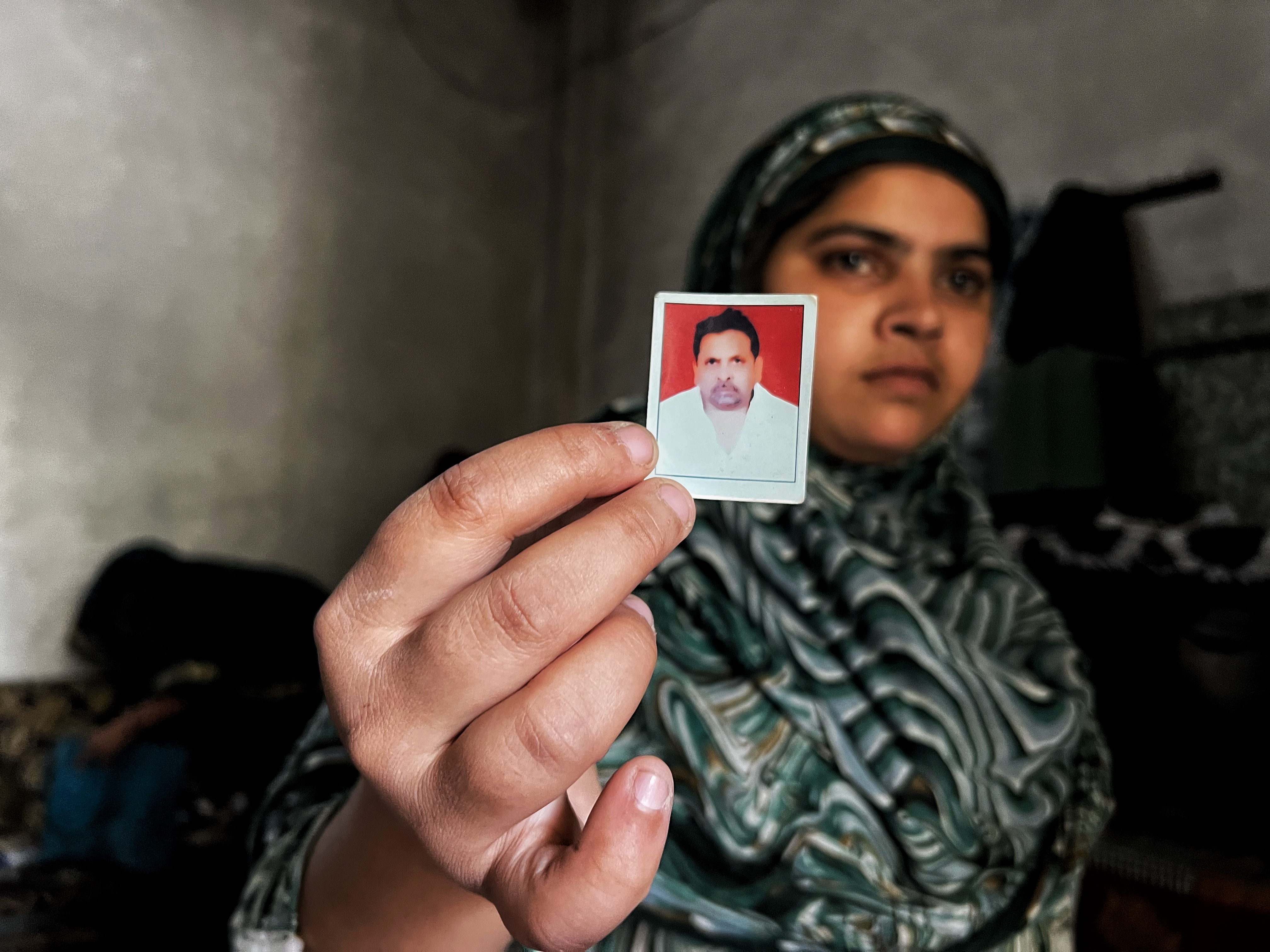
Naseema
A few kilometers away, Naseema was waiting for her husband. “He asked me to prepare lunch. He said he would be back.” But Qasim did not return.
Naseema could not imagine what was happening just 10 kilometers away at Samaydeen’s farm. “We had no enemies,” she says.
It was only later that she understood why her husband had been killed. “They attacked him just for being a Muslim.”
The Lie That Killed Qasim
The lie that killed Qasim sprouted in toxic and fertile soil. Since 2017, India has been shaken by a wave of lynchings instigated by fake news propagated through WhatsApp.
These rumors have demonized the Muslim community with accusations ranging from conspiracy theories like “love jihad”—an idea driven by the far-right accusing Muslim men of seducing Hindu women to forcibly convert them to Islam—to falsehoods about cow slaughter, an animal considered sacred in the Hindu religion.
The messaging platform’s encryption, designed to protect privacy, prevented authorities from tracing the origin of the hoaxes. This forced the Indian government to threaten WhatsApp with being labeled an “accomplice,” to which the company responded with measures such as the “forwarded message” label.
Parallel to this wave of disinformation, the vigilantism of the “Gau Rakshaks”—literally “cow protectors”—flourished in the country. These groups arrogate the right to dispense justice by their own hand, often with extreme violence.
This phenomenon intensified notably after the rise to power in 2014 of the Bharatiya Janata Party (BJP), the Hindu nationalist party of current Prime Minister Narendra Modi.
Although the government does not officially endorse violence, human rights organizations point out that its rhetoric and the tightening of laws against cow slaughter created a climate of impunity that emboldened these extremist groups.
Qasim was a victim of that lethal confluence. Samaydeen, a complete stranger who was also Muslim, got trapped in it.
“Cow Killers!”
On the farm that day, Samaydeen saw Qasim arrive running, stumbling as the mob caught up with him. The farmer did not hesitate and ran to stop the assault. The mob turned against him. “Cow killers!” they shouted at him as sticks and cudgel blows rained down on him too.
Alone, with his work sickle in hand, he tried to reason, but there was no dialogue. “They started beating me too,” he says, recalling how they dragged him along with Qasim out of the farm.
The initial group grew to a hundred, then a hundred and fifty people. Every newcomer joined the beating.
The ceaseless violence left Samaydeen with a shattered body—hands, a leg, and several ribs broken. When Qasim, dying, begged for a sip of water, his executioners laughed.
The Battle After the Battle
After an hour of waiting, the police arrived but hesitated before the mob. Only with reinforcements did they manage to rescue them.
Then began the journey through hospitals. A first center refused to treat them, fearing their imminent death. It was at the second that an officer announced Qasim’s death. Samaydeen woke up later in another hospital with a fractured body and 32 stitches in his head.
The physical aftermath is permanent. “I can no longer do any physical work… They have made me useless,” states the farmer.
The initial investigation to clarify what happened was an attempted cover-up, according to Samaydeen’s lawyer, Mohammed Furqan Qureshi.
“The administration tried to sell it as an accident,” he assured. However, pressure generated by the viral spread of lynching images and the confession of one of the killers recorded by an undercover journalist forced authorities to investigate the case correctly.
After a legal battle of nearly six years and 223 hearings, in March 2024, the Hapur court issued a historic sentence, condemning ten men to life imprisonment.
The verdict also harshly criticized police negligence and brought relief to the family, who had suffered years of intimidation.
“We were very scared,” admits Yasin, Samaydeen’s brother. “They wouldn’t let us leave the village. Our village is small and theirs is very big.”
The Scars of the Present
Despite the pressure, the family stood firm and rejected offers for a “compromise” between communities. This is a frequent practice in rural India where violent disputes are settled with money to avoid police intervention and “save the honor” of the villages. “We wanted the guilty to pay for their crimes,” asserts Samaydeen.
But justice does not erase the past. “Life is very hard since he died,” confesses Naseema, inside the house that now confines her with her memories.
Justice does not extinguish nightmares either. Samaydeen suffers a wound that opens every night. “Sometimes I feel like they are really beating us,” he relates. “When I wake up, my heart beats fast and my body trembles.”
Fear also reappears during the day when religious processions pass through his village using chants like “Jai Shri Ram”—”Victory to Lord Ram”—a religious slogan appropriated by Hindu nationalists as a cry of intimidation. “All this is done to instill fear,” explains Yasin.
There was no cow slaughtered. There was no prior crime. Only a lie that unleashed horror in Hapur. Today, that same sun beats down on the farm where Samaydeen lives with his memories. His gaze, fixed on the path Qasim ran down, is the mark of a present that, like this whole story, was born of a lie. EFE
 Indira Guerrero