A View from Inside the Riot Tank
By Indira Guerrero
Caracas (Venezuela).– Dusk falls over the asphalt of the Francisco Fajardo highway in Caracas. The ground is littered with the remains of tear gas canisters, rubber bullets, marbles, and Molotov cocktails—the debris of anti-government protests that end in clashes with the National Guard in Venezuela.
The year was 2017. For months, the country was paralyzed by a wave of demonstrations against President Nicolás Maduro. While most reporters covered the chaos from the side of the protesters, I was granted rare access to the other side of the trench. This story was written from the vantage point of a military vehicle, embedded with the troops charged with suppressing the revolt.
Hours earlier, dozens of uniformed men wearing vests, shields, and masks stood under a bridge listening to a lecture from their commander about “fourth-generation warfare” and how the method of “non-violence” could be an attempt to dethrone their commander-in-chief.
“This man, Gene Sharp, has designed a method to execute soft coups,” Major General Antonio Benavides repeated, standing on a jeep, commanding the full attention of the troops. Most of them were young men, barely thirty years old, listening impassively.
The thesis came from a book Benavides was reading to them titled Testimonies of a Unconventional War. On one of its pages, he attributed a phrase to the American philosopher: “Non-violence as a technique of political action can be used for any end.”
During 64 days of protests, authorities counted more than 2,800 demonstrations, 800 of them violent. Estimates suggest 600,000 people participated, leaving 63 dead and more than a thousand injured.
The Bolivarian National Guard (GNB) is the military component used in Venezuela for riot control. To the opposition, it is the repressive arm of the dictatorship. To the government, it is the guarantor of peace.
There are just a few minutes of stillness when the opposition marches meet the GNB platoons at the edge of the imaginary wall on the highway. There, public forces wall off the side of the city prohibited to anti-chavismo.
On the west side, hundreds of soldiers with shields, masks, and tear gas shotguns advance, accompanied by a caravan of armored vehicles.
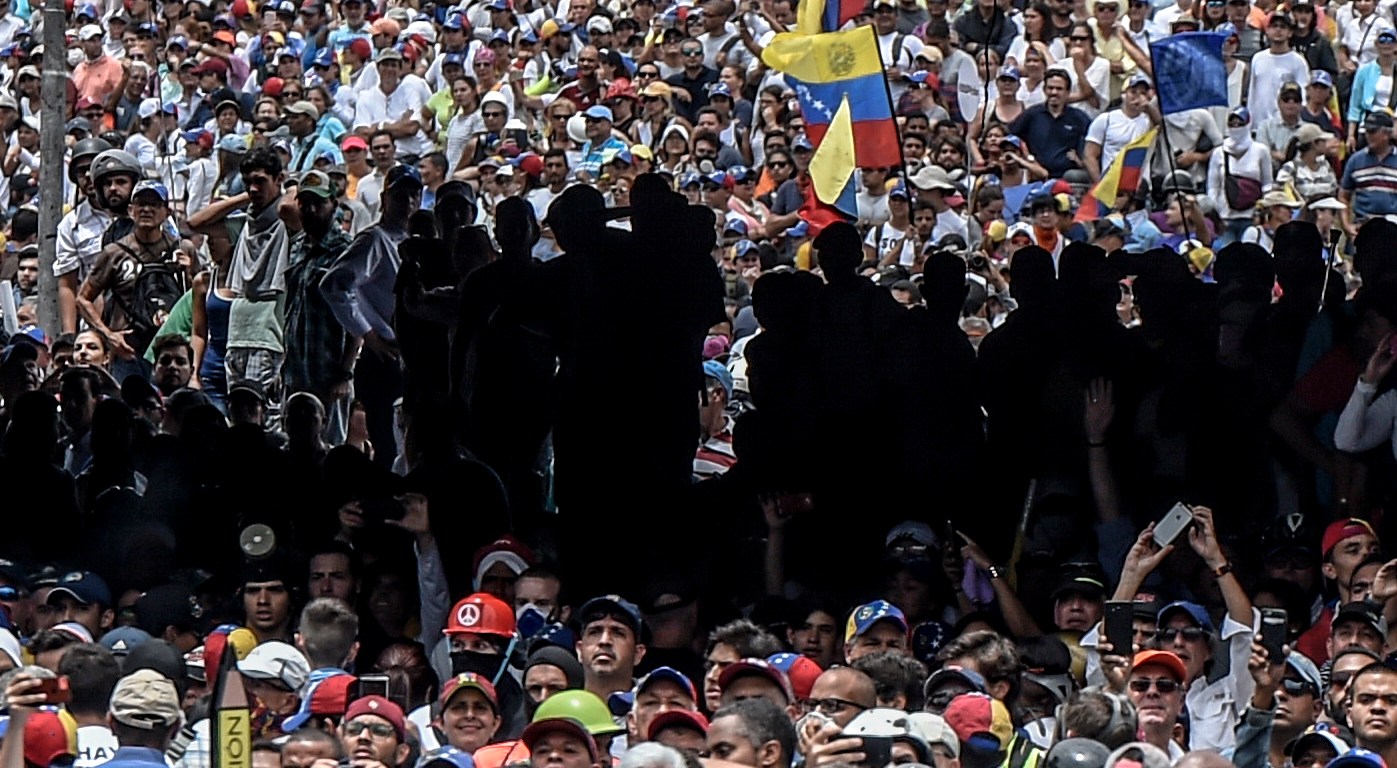
On the east side, thousands of people form a white column of demonstrators protesting against the government, its project to rewrite the Constitution, and one of the most critical moments of the Venezuelan economy.
From my position looking through the protective grille of one of the armored tanks, I watched the endless and diffuse column of people. I saw a young man, almost a teenager, separate from the crowd, take a step forward, and wave his hands with his palms facing out.
Inside the operation, what is heard is an officer repeating three or four times over the loudspeaker: “You cannot demonstrate on the highway.” “Retreat from the highway.”
Two more warnings and the negotiation ends. The minutes of truce, which seem eternal on one side and mere seconds on the other, are over.
A firework rocket fired from a building breaks the moment, while the precise shot of a water cannon from a riot control tanker hits the demonstration with a pressure of 1.6 megapascals.
Soon the shouts of the demonstration are drowned out by the sound of tear gas fired from shotguns and tanks, as well as the noise of shattering Molotov cocktails, rockets, stones, and tin shields.
In a short time, there are no immunities or rights. There is no private property or protocols. Everyone carries their wounded. The ground is left covered in pellets, marbles, and ammunition that no one claims.
The tanks leave, broken by bullet impacts or set on fire. First aid medics report being robbed or attacked by officers. Pieces of uniforms and shoes of boys who ran in desperation are left behind.
And when the column of demonstrators has run, only the usual ones remain, those who have faced each other on the same highway so many times, hidden behind masks.
The GNB and “The Resistance.” Two fronts of the same generation, trapped in the same crisis.
The clash between them is the final chapter of each day of protest. Sometimes, it extends for hours. In the end, the sun goes down, and everyone goes home with one more reason to return tomorrow. EFE
 Indira Guerrero