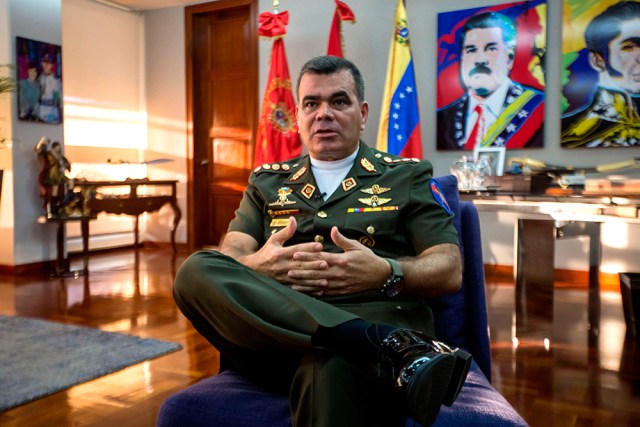
Venezuela’s Defense Minister
Caracas (Venezuela).– Outside, Caracas smells of tear gas, thirty-five days of protests have passed, thirty-five people are dead, and the main highway is a daily battlefield. But in here, inside the office of the Minister of Defense, the air conditioning freezes reality. Everything is silent. Everything is in order.
Sitting across from the table is Vladimir Padrino López, the man who holds the keys to the tanks and, therefore, the keys to power in Venezuela. He does not look like a man at war, though he speaks of one. He speaks of an invisible “unconventional war,” faceless and vague, to justify the chaos roaring on the other side of his soundproof windows.
It is Friday, May 5, 2017. The country is burning, but the General is calm.
INDIRA GUERRERO: Minister, let’s start with the government’s narrative. You claim Venezuela is facing a “Fourth Generation War,” an invisible enemy. But isn’t that just a rhetorical shield to avoid taking responsibility for the economic collapse and the unrest in the streets?
VLADIMIR PADRINO LÓPEZ: That is why you don’t see the face of an unconventional war; it doesn’t exist physically. It is difficult to identify. The muscle of this war has been economic. Have you noticed that every time there is a political event of importance, there is a repercussion in the economy?
IGR: Let’s talk about the Constituent Assembly. President Maduro has called for a process to rewrite the Constitution without a prior referendum. Legal experts and half the country consider this a rupture of democracy. Why has the Armed Forces decided to back a process that many call illegal?
VPL: The first question a soldier asks is: Is this framed within the Constitution? When the head of state makes such an important announcement, one says, “Okay, let’s look at the Constitution.” And yes, it is there. Therefore, it has the inescapable, indisputable support of the Armed Forces.
IGR: But the crisis began because the Supreme Court stripped the opposition-controlled Parliament of its powers. This was widely denounced as a coup d’état. Can you assure us that the military would defend the Constitution if it were violated by Chavismo or even by President Maduro himself?
VPL: If we have learned anything in these years of revolution, it is what Commander Hugo Chávez taught us: to love and defend the Constitution. That is an indefectible task.
IGR: I insist on the concrete fact. Would you stop the government if it broke the law?
VPL: We do not look at who breaks the constitutional thread; we look at the fact. Just as it happened in 2002… In this case, a sentence was issued, a power pronounced itself, and the head of state solved the impasse in hours. How can we call that a coup d’état? I don’t see it as a coup. For us, it was an impasse that was solved.
IGR: Meanwhile, the streets are filled with dead bodies. There are videos showing the National Guard firing tear gas directly at protesters and beating civilians. Do you deny this repression?
VPL: There are videos and videos. Some are true, and we assume responsibility for some isolated excesses. If an official exceeds his authority, there is a principle of responsibility. But the National Guard is acting to prevent the infringement of third-party rights. We cannot allow free transit to be violated by violent people who want to close the highway.
IGR: In a move that recalls the darkest dictatorships of the region, civilians arrested in protests are now being tried in military courts instead of civilian ones. Why is the Armed Forces judging students and protesters as if they were soldiers?
VPL: When there is an aggression against a sentinel, or an official, or a military asset, that perfectly incurs a military crime and can fall under military jurisdiction.
IGR: But the number of cases has spiked coincidentally just as the Attorney General has distanced herself from the government. Is this a maneuver to bypass civilian justice?
VPL: No. In matters of law, there is not much space to be on one side or the other. If someone is caught in flagrante attacking a sentinel, military jurisdiction is competent.
IGR: Let’s turn to Leopoldo López, the country’s most prominent political prisoner. His family holds you personally responsible for his life. Recently, a “proof of life” video was aired on state TV where he appeared humiliated. Did you authorize that?
VPL: Of course. There was a rumor that set off international alarms. I called the prison director, he told me the prisoner was fine, and asked for authorization to show him. I said yes. Of course.
IGR: Finally, I need to ask about the “Bolivarian Militias”—that corps of civilians uniformed and trained by the government. President Maduro talks about expanding them to 500,000 members. Are there real weapons for half a million civilians?
VPL: There are weapons for all of them, of course.
IGR: Wait. The regular Armed Forces have about 180,000 active troops. Are you confirming there are more rifles for militiamen than for professional soldiers?
VPL: Not “armed” in the sense that they have them at home. The weapons are in the armories. But yes, there are weapons for all of them. They are for defending the homeland.
IGR: A parallel army of civilians with 400,000 rifles. And you say no one should fear that?
VPL: No one.
 Indira Guerrero